

Lagatar24 Desk
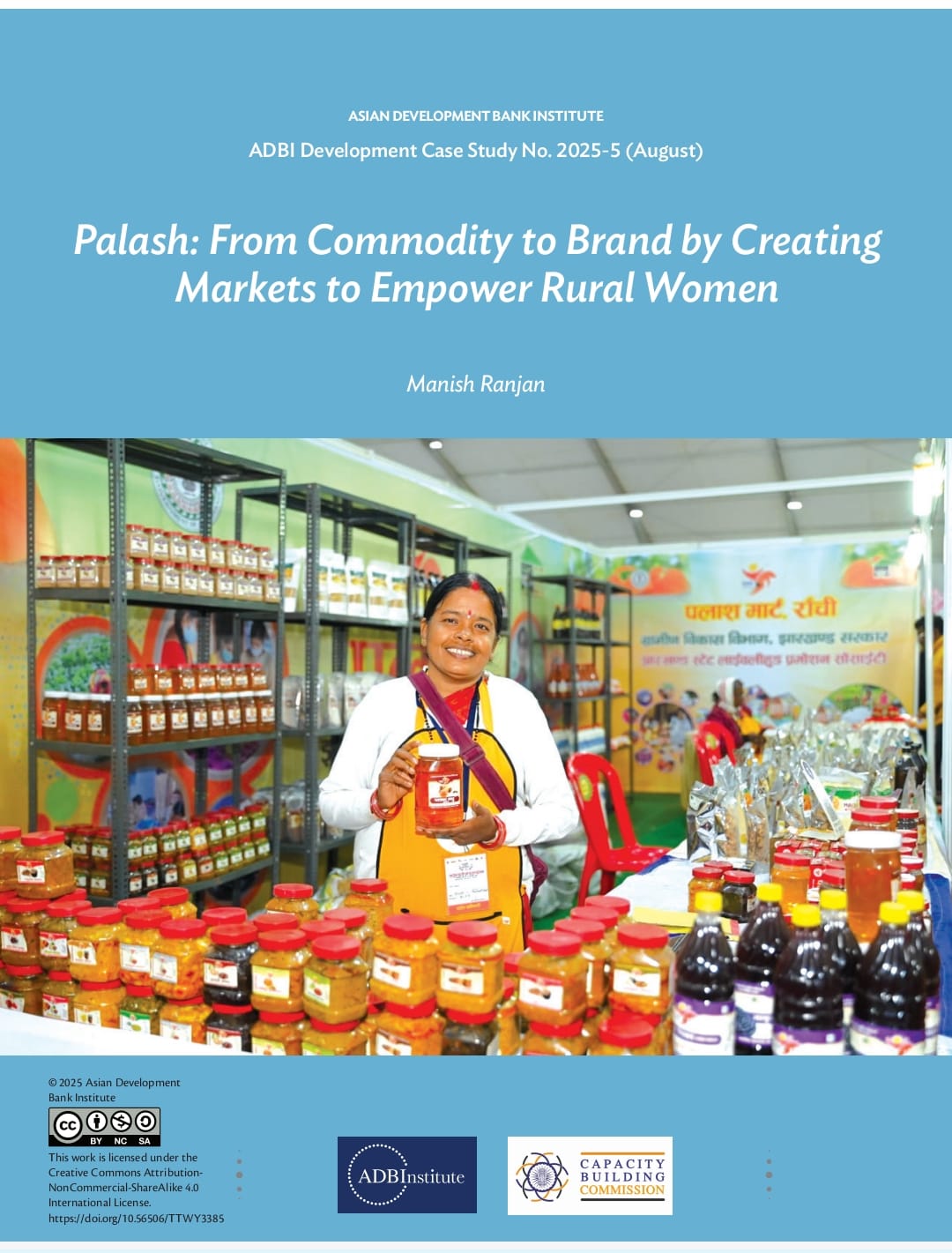
Ranchi: The Asian Development Bank Institute (ADBI) has released an India-focused teaching case authored by Dr. Manish Ranjan, IAS (Jharkhand cadre), titled “Palash: From Commodity to Brand by Creating Markets to Empower Rural Women.” The case reflects Chief Minister Hemant Soren’s vision of expanding livelihood opportunities for rural women in Jharkhand and highlights a scalable model of grassroots empowerment.
From Self-Help Groups to the ‘Palash’ Brand
At the heart of the case is the story of Jharkhand’s women-led self-help groups (SHGs) who aggregate their production and market collectively under the unified “Palash” brand. By negotiating together, these groups gain higher prices, stronger bargaining power, and more stable livelihoods. The teaching case illustrates the challenges of building such models, including issues of quality control, pricing, distribution costs, and organizational design—providing MBA students and policy schools with real-world dilemmas to debate.
Global Recognition and Academic Adoption
Within just 24 hours of its publication, top institutes including IIM Ahmedabad, XLRI, IIM Indore, and MDI Gurgaon sought permission to integrate the case into their curricula. Its inclusion in ADBI’s global case series ensures immediate international exposure, reaching classrooms, policy schools, and executive programs worldwide. This gives Indian public-sector innovations like Palash a platform for global adoption and dialogue.
Scholarship and Practitioner-Led Insights
Dr. Ranjan, a Chevening Fellow at Oxford, UC Berkeley alumnus, and National e-Governance Awardee, brings rigorous scholarship and field experience to the case. Known for an academic feat at Berkeley—scoring above 100 percent in a statistics course—his analytical depth strengthens the case’s credibility. Co-published with India’s Capacity Building Commission, the work signals a shift towards bureaucrats translating frontline governance into globally relevant knowledge.
A Step Toward Expanding India’s Soft Power
Beyond documenting Palash’s success, the case emphasizes India’s growing role in shaping global development pedagogy. It demonstrates how governance-led models can create markets that empower women, while also exposing learners to the professional and ethical dilemmas of working with vulnerable groups. If scaled, such cases could expand women-led enterprise frameworks, enrich management education, and enhance India’s intellectual soft power worldwide.