
Lagatar24 Desk
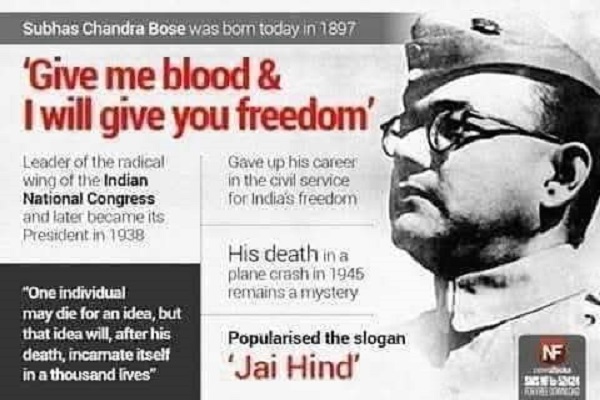
Cuttack: Netaji Subhas Chandra Bose, one of India’s most iconic freedom fighters, was born on January 23, 1897, in Cuttack, Odisha, into a well-educated Bengali family. His life was marked by intellectual brilliance, revolutionary nationalism, and an unyielding commitment to India’s independence.
Early Life and Education
Subhas Chandra Bose was the ninth child of Janakinath Bose, a renowned lawyer, and Prabhavati Devi. He received his early education at Ravenshaw Collegiate School in Cuttack and later studied at Presidency College and Scottish Church College in Calcutta. He went on to England to prepare for the Indian Civil Services examination at Cambridge University, where he secured the fourth rank, an extraordinary achievement for an Indian under British rule.
From Civil Servant to Revolutionary Leader
Deeply moved by India’s freedom struggle, Bose resigned from the Indian Civil Services in 1921 and returned to India to join the Indian National Congress. While he shared the goal of independence with Mahatma Gandhi, he differed in approach, strongly believing that armed resistance might be necessary. Despite ideological differences, Bose was the first to address Gandhi as the “Father of the Nation.”
Leadership in the Indian National Congress
Bose was elected President of the Indian National Congress in 1938 and again in 1939. During his tenure, he established the National Planning Committee, reflecting his vision for a modern, industrialized India. However, growing differences with the Gandhian leadership forced him to resign and chart an independent political course.
The Strategy of ‘Enemy’s Enemy’
With the outbreak of World War II, Bose believed Britain’s global conflict presented an opportunity for India’s freedom. Placed under house arrest by the British, he escaped dramatically and traveled through Afghanistan and the Soviet Union to Germany. His strategy was based on the belief that Britain’s enemies could become India’s allies in the struggle for independence.
Azad Hind Fauj and the Provisional Government
In 1943, Bose moved from Germany to Japan and then to Singapore, where he assumed leadership of the Azad Hind Fauj (Indian National Army). He reorganized the army, formed the Rani of Jhansi Regiment for women under Captain Lakshmi Sehgal, and on October 21, 1943, announced the formation of the Provisional Government of Free India. His rallying cry, “Give me blood, and I will give you freedom,” became immortal.
Personal Life and Ideals
In 1937, Bose married Emilie Schenkl, an Austrian national, and they had a daughter, Anita Bose. Despite his personal commitments, his life remained devoted to the cause of national liberation, discipline, and sacrifice.
The Mystery of His Disappearance
It is officially stated that Netaji died in a plane crash near Taiwan on August 18, 1945, while traveling to Japan. However, his body was never recovered, leading to enduring controversy and speculation. One prominent belief suggests that he lived on in secrecy as “Gumnami Baba” in Faizabad, a theory supported by certain documents and personal belongings, though never officially accepted.
Enduring Legacy
Netaji Subhas Chandra Bose remains a symbol of fearless patriotism, strategic brilliance, and unresolved mystery. His life continues to inspire generations with the ideals of courage, sacrifice, and unwavering love for the nation.