
Lagatar24 Desk
Moscow/Kyiv: A fire broke out on Sunday at the Zaporizhzhia nuclear power plant, Europe’s largest, now under Russian control in Ukraine. Both Moscow and Kyiv are trading accusations over who is responsible for the incident, which has heightened tensions in the ongoing conflict between the two nations.
The International Atomic Energy Agency (IAEA), which has a presence at the six-reactor facility in southern Ukraine, reported seeing thick, dark smoke rising from the northern area of the plant following a series of explosions. Despite the fire, both sides have confirmed that no elevated radiation levels were detected.
Russian state news agencies, TASS and RIA, reported that the main fire was extinguished shortly before midnight, according to the country’s nuclear energy company, Rosatom. The incident comes just days after Ukrainian forces launched their most significant incursion into Russian territory since the war began in 2022, signaling a new phase in the conflict after weeks of Russian battlefield gains.
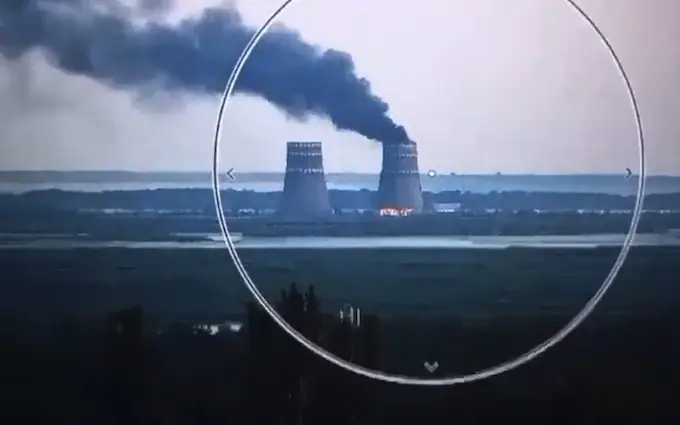
Ukraine’s nuclear power company, Energoatom, stated that one of the cooling towers and other equipment were damaged in the fire. Russia’s TASS agency also confirmed damage to a cooling tower, citing Rosatom and local Russian emergency ministry representatives, who described it as a non-functioning tower.
The Zaporizhzhia plant, which has been under Russian control since the early days of the invasion in 2022, has its six nuclear reactors in cold shutdown. However, the plant’s strategic significance and its proximity to the front lines make it a focal point of concern.
By early Monday, the exact cause of the fire, which began around 8 p.m. local time on Sunday, remained unclear. Ukrainian President Volodymyr Zelensky accused Russia of starting the fire, which he claimed was visible from the Kyiv-held city of Nikopol, across the river from the Russian-occupied plant.
In contrast, Evgeny Balitsky, a Russian-appointed official in the occupied south of Ukraine, blamed Ukrainian forces for the fire, alleging they shelled the nearby city of Enerhodar, also under Russian control since early in the invasion.
The IAEA confirmed that the fire had not impacted nuclear safety at the site. The agency noted that its team was informed of a possible drone attack on one of the plant’s cooling towers.
Energoatom suggested that Russian negligence or intentional arson could have sparked the fire, further claiming without evidence that Russia was storing military equipment and explosives in the plant’s cooling towers. Russian officials, including Foreign Ministry spokeswoman Maria Zakharova, accused Kyiv of attempting to destroy the plant deliberately and spreading “nuclear terror.”
President Zelensky shared a grainy video purportedly showing black smoke billowing from a cooling tower with flames visible at its base. He reassured that radiation levels remained normal but warned that the situation could never be considered normal as long as Russian forces control the nuclear facility.
While the six reactors are not currently operational, the plant still relies on external power to maintain the cooling of its nuclear material, essential to preventing a catastrophic accident. Both Russia and Ukraine have repeatedly accused each other of jeopardizing safety around the plant, adding another layer of danger to the ongoing conflict.