

Lagatar24 Desk
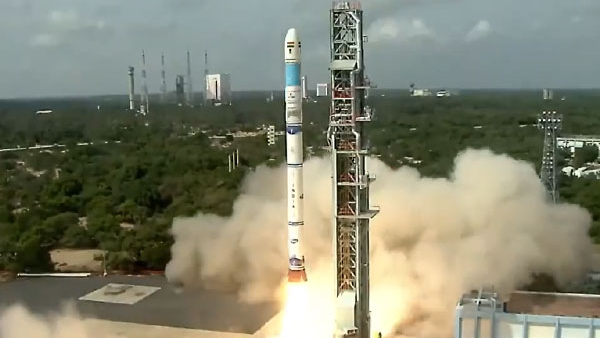
Sriharikota: The Indian Space Research Organisation (ISRO) has successfully launched its Earth Observation Satellite-8 (EOS-8) using the newly developed Small Satellite Launch Vehicle (SSLV) from the Satish Dhawan Space Centre. This launch marks a significant milestone in India’s space ambitions, paving the way for more cost-effective and efficient space missions.
The SSLV, often referred to as ISRO’s “Baby Rocket,” carried two payloads: the EOS-8, an experimental earth imaging satellite, and the SR-0 Demo Sat, developed by Chennai-based start-up Space Rickshaw. Weighing just 120 tonnes, the SSLV can deploy satellites of up to 500 kilograms into low Earth orbit, making it a nimble and versatile launcher compared to India’s heaviest rocket, the 640-tonne Geosynchronous Satellite Launch Vehicle (GSLV Mk 3), famously known as Bahubali.
Aligning with ISRO’s commitment to affordable space exploration, the SSLV was developed at a cost of Rs 170 crore, taking seven years to build. Although ISRO has not disclosed the exact cost of this launch, experts estimate that each SSLV mission would cost between Rs 30-35 crore, positioning it as one of the most economical launch vehicles in its category.
A notable feature of the EOS-8 satellite is its onboard instrument that measures ultraviolet (UV) light exposure. This technology will play a crucial role in India’s upcoming manned space mission, Gaganyaan, by monitoring the astronauts’ exposure to potentially cancer-causing UV radiation.
ISRO Chairman Dr. S. Somanath praised the SSLV for its simplicity and ease of production, highlighting its potential to revolutionize the commercial launch sector. “The SSLV is designed for large-scale production, flexible integration, and minimal testing before launch. The entire rocket can even be stored until needed,” Dr. Somanath explained.
This launch comes as part of India’s broader efforts to privatize its space sector, with the government opening up opportunities for private companies to develop small satellite launch vehicles. This move has already garnered interest from 20 companies, underscoring the commercial potential of the SSLV.
Globally, the small satellite industry was valued at $3.25 billion in 2020 and is expected to grow to $13.71 billion by 2030, according to a Bloomberg report. With the successful deployment of the SSLV, India is well-positioned to capture a significant share of this booming market.