
As India celebrates its Republic Day, the essence of democracy in Jharkhand flows not just from Delhi’s Red Fort but also from the village akhara and the traditional Munda-Manki governance systems. The very idea of a republic—people’s rule—has long existed in this land through its nature-aligned lifestyle and community-based systems. Jharkhand is not just a land of minerals but a living document of harmony between 32 different tribal and non-tribal communities.
Ancient Democratic Roots and Social Harmony
Over 91% of Jharkhand’s tribal population still resides in rural areas, upholding age-old traditions. The Munda-Mankigovernance model of the Ho tribe reflects ancient grassroots democracy where decisions are made collectively. While patriarchal in structure, women continue to enjoy high respect in society. Nearly 60% of the state’s population is from the Sadan community—non-tribal, agrarian residents who complement tribal groups in sustaining social unity. Their diversity strengthens the foundation of India’s democracy.
Cultural Heritage: Art and Aesthetics in Motion
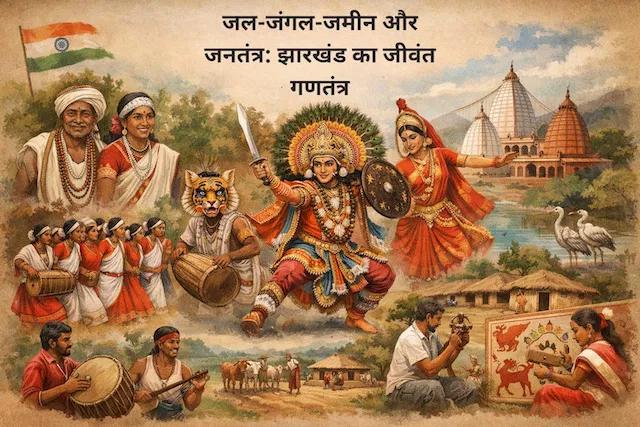
Jharkhand’s republic breathes through its arts. The globally recognized Chhau dance, born in Seraikela, showcases mythological tales through ornate masks, merging valor and romance. The Paika dance, with its martial movements and weapons, celebrates ancestral heroism. The scroll-style Paitkar paintings from Amadubi village and the mural art forms of Sohrai and Kohbar turn walls into sacred canvases of agricultural and matrimonial life, reflecting deep ties to nature and community rituals.
Language and Literature: The Lifeblood of Identity
The strength of a republic lies in its linguistic diversity. Jharkhand is a confluence of Austric and Dravidian languages. Santhali, included in the Eighth Schedule of the Indian Constitution in 2004, shines as a linguistic pride, supported by the Ol Chiki script developed by Pandit Raghunath Murmu. Writers like Ahlad Tirkey and Bihari Lakra have enriched the Kudukh literature, while Khortha, Nagpuri, Panchpargania, and Kurmali languages of the Sadan communities keep local traditions alive. Nagpuri, once spoken by the Nagvanshi rulers, continues to enchant with its melodic tone.
Festivals and Nature: Sacred Bonds with Earth
Festivals in Jharkhand embody the philosophy of coexistence with nature. Sarhul, the largest tribal festival, celebrates the blooming Sal flowers in March, with sacred rituals under Sakhua trees. Karma honors sibling bonds and natural harmony. Sohrai, held a day after Diwali, expresses gratitude for domestic animals, while Manda Puja involves walking over burning embers in devotion to Lord Shiva. Community fairs like Tusu and Hajla echo the unity of people across villages and valleys.
Spiritual and Historical Grandeur
Temples in Jharkhand are pillars of spiritual consciousness. Deoghar’s Baidyanath Dham, home to one of the twelve Jyotirlingas, hosts the world’s largest religious fair, the Shravani Mela. The Chhinnamastika Temple at Rajrappa, nestled at the confluence of Damodar and Bhairavi rivers, is a shrine of immense Shakti devotion. The Jagannath Temple in Ranchi and the Sun Temple in Bundu, hailed as poetry in stone, reflect architectural excellence. Historical sites like Palamu Fort, Navratnagarh Palace, and Teliagarh in the Rajmahal Hills narrate tales of glory and resilience.
Music and Instruments: Jharkhand’s Pulsating Heartbeat
Music is inseparable from Jharkhand’s soul. Every rite of passage is accompanied by folk songs—Jhanjhain at birth, Domkach at weddings. The Mandar drum, an ancient and beloved instrument, resonates through valleys. Alongside the Nagada, Dhol, Flute, and Kendra, these instruments create music that touches the soul and strengthens cultural identity.
As we recite the Preamble on Republic Day, let us remember Jharkhand’s indigenous systems that taught us participation and equality. Cultural diversity is our strength. The legacy of Ol Chiki script, Chhau masks, and the message of Sarhul must be passed to the next generation. True development in Jharkhand lies not just in roads and industries, but in preserving languages like Santhali, Mundari, and Kurukh, and promoting arts like Paitkar and Sohrai.