


Lagatar24 Desk
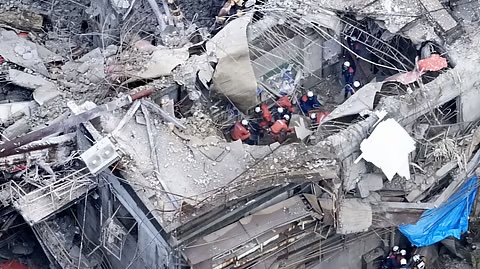
Tokyo: Two days after a powerful 7.1-magnitude earthquake struck southwestern Japan, the death toll has climbed to 30, with widespread destruction reported across the region, including an explosion at a shopping mall, a collapsed factory chimney, and flattened homes in the city of Yatsushiro, alongside cracked roads and damaged buildings.
Rescue Efforts Continue as Military Personnel Deployed
Emergency responders are racing against time to rescue people trapped beneath the rubble, with Prime Minister Sanae Takaichi mobilising thousands of military personnel to strengthen search and rescue operations across the affected areas.
Nearly 58,000 Households Remain Without Power and Water
As of Thursday, many of the nearly 58,000 households in the affected port city remained without electricity and running water, as authorities continued restoration efforts. Relief operations official Matsushita said it was too early to estimate when the badly damaged water mains would be repaired, noting that the process could take days, weeks or even months, adding that the lack of water was especially difficult given the summer heat. With building toilets rendered unusable, officials installed temporary emergency toilets over sewer manholes outdoors, as residents endured temperatures of around 35°C amid high humidity.
Japan’s Earthquake Preparedness Rooted in Past Disasters
Japan remains among the world’s most earthquake-prone countries due to its location at the convergence of four major tectonic plates and along the Pacific Ring of Fire, a seismically active belt spanning roughly 40,000 kilometres. Despite this constant threat, the country has invested heavily in earthquake preparedness, including advanced early warning systems, disaster response mechanisms and earthquake-resistant infrastructure. Stricter building codes introduced in the 1980s proved highly effective during the 1995 Kobe earthquake, which had claimed more than 6,000 lives.
Older Structures Prompt Renewed Focus on Retrofitting
Investigations into the latest disaster found that most buildings which collapsed had been constructed before the revised building codes came into effect, prompting Japan to accelerate efforts to retrofit older structures, reinforce construction standards, and further strengthen its disaster preparedness and emergency response systems.