

Lagatar24 Desk
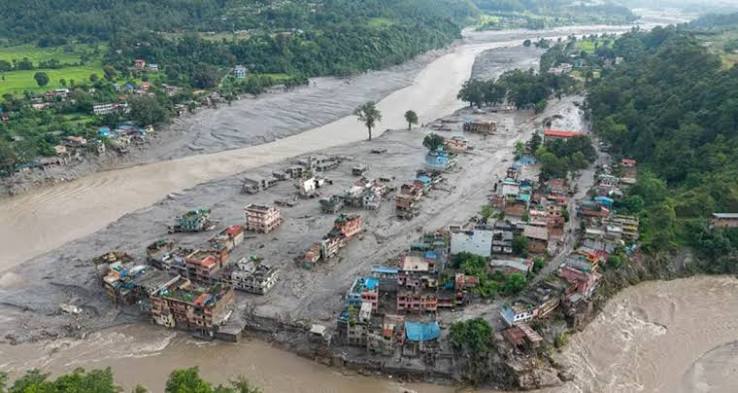
Kathmandu: The death toll from the August 26 Himalayan flood in Nepal and Tibet has risen to 1,066, with 4,462 people still reported missing, as rescue operations enter a critical phase amid dimming hopes of finding survivors.
Nepal, China Report Combined Death Toll and Missing Figures
Of the total deaths, 1,050 were reported in Nepal and 16 in Tibet. Nepal’s National Disaster Risk Reduction and Management Authority has listed 3,916 people as missing, including 583 foreign nationals, while China has reported an additional 546 people missing in Tibet.
Hope of Open-Area Survivors Fading Seven Days After Flood
Seven days after the flood, hopes of finding survivors in open areas along the Bhote Koshi-Trishuli corridor have sharply dimmed. Senior officials told reporters that, outside tunnels, underground powerhouses and other protected structures, any successful rescue at this stage would now be considered a miracle, even as search teams continue combing stretches buried under sludge, boulders, uprooted trees and debris. A senior Nepal Police officer coordinating ground operations said the sheer volume and force of the flash flood had left virtually no accessible pockets of shelter along the open riverbanks, though search efforts have not been called off.
Army Officer Says Remaining Hope Centred on Underground Sites
A senior Nepalese army officer involved in downstream search efforts said field units and canine squads continue covering vast stretches of silt, but that the ground reality remains extremely grim, with anyone caught in the open having borne the direct brunt of heavy boulders and torrents. He noted that the remaining operational hope for living survivors is largely concentrated on underground project sites where air pockets might still exist.
India’s Missing Persons Count Remains at 275 Nationals
For India, the Ministry of External Affairs’ latest missing-person count remained unchanged at 275 Indian nationals and 128 Persons of Indian Origin (PIOs), with the figure not revised on Tuesday. The ministry confirmed that 158 Indian nationals had been rescued by Monday night.
Hydropower Project Sites Offer Strongest Remaining Hope
The strongest remaining hope for survivors now centres on Nepal’s devastated hydropower projects, with NDRRMA listing 639 people associated with hydel projects as missing, while the Independent Power Producers’ Association Nepal (IPPAN) reported 894 people out of contact across 11 projects. Officials estimated that around 500 people could have been inside tunnels when the flood struck, though the exact number underground has not been confirmed.
Rescue Efforts Hampered by Blocked and Collapsed Tunnels
Floodwater, boulders and thick slurry have blocked passages and caused tunnel collapses at multiple sites. At Upper Trishuli-1, rescuers advanced roughly 160 metres before encountering a blocked passage, while at Chilime, teams reached about 150 metres before facing a completely buried section. At Upper Trishuli-3A, rescuers used excavators, compressors and rock breakers to create an opening, but a rush of water forced them to attempt an alternate approach, with access work continuing at Upper Trishuli-3B.
International Teams Assist in Rescue Operations
Indian specialist teams have been working alongside the Nepal Army at Chilime and Langtang, while Chinese tunnel experts joined operations at Upper Trishuli-3A. An Indian team probed up to 185 metres inside the Langtang tunnel, and India has also sent forensic specialists, including DNA experts, to assist in identifying recovered bodies. At the Rasuwagadhi Hydropower Project, a thermal drone sent inside one tunnel detected no signs of life in the surveyed section, with drone operator Manish Maharjan describing parts of the tunnel as being packed with mud, likening it to toothpaste in a tube, with mud, water and debris filling 80-90 percent of the tunnel’s height in some areas.
Tunnels Still Offer Hope Amid Grim Conditions
Despite the bleak conditions, tunnels and underground powerhouses continue to offer a possibility the devastated riverbanks do not, namely protected chambers with pockets of air. Nepal Tunnelling Association secretary Chhatra Bahadur Basnet said hope remains for finding survivors underground, though he cautioned that limited oxygen, food and water supplies make every passing hour increasingly critical.