

Lagatar24 Desk
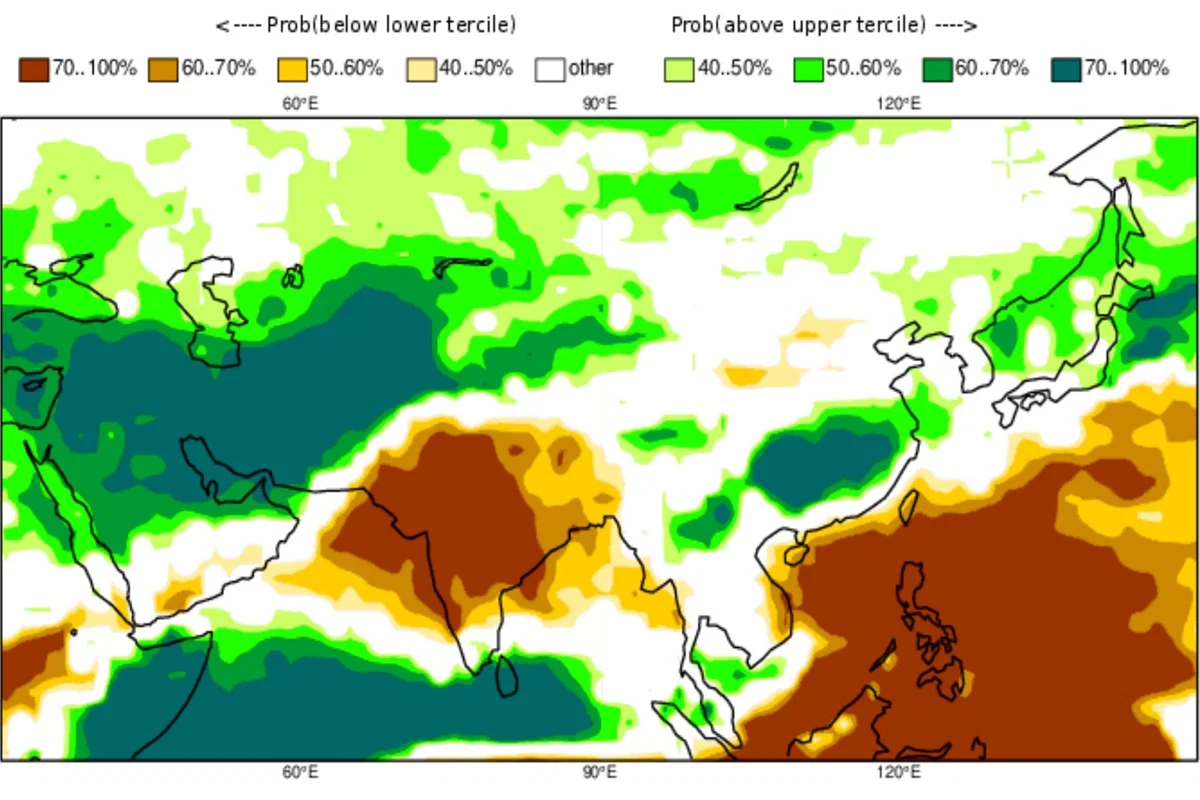
While India’s southwest monsoon appears to be losing momentum, with a powerful cyclone active in the Pacific Ocean pulling monsoon clouds eastward and reducing rainfall across parts of western and southern India, leading to near-drought conditions in some areas, fresh relief is expected during the 2026 northeast monsoon season (October to December), according to the latest seasonal forecast from the European Centre for Medium-Range Weather Forecasts (ECMWF).
Kerala, Tamil Nadu Likely to See Above-Normal Rainfall
According to ECMWF, Kerala, Tamil Nadu and areas around Sri Lanka are likely to receive above-normal rainfall during the northeast monsoon, as these regions depend heavily on the season’s northeasterly winds from the Bay of Bengal, which carry significant moisture. However, northern Tamil Nadu and surrounding areas show no particularly strong signals either way, though normal rainfall is still expected there.
El Niño and IOD Expected to Influence Monsoon Patterns
Weather scientists say El Niño could strengthen this year, a phenomenon that typically weakens the southwest monsoon, though its impact on the northeast monsoon may differ. Meanwhile, a positive Indian Ocean Dipole (IOD) is also expected to develop, which could increase moisture flow from the Indian Ocean toward India, a pattern generally considered favourable for rainfall in southern India.
Local Weather Systems May Boost Rainfall Further
Experts noted the possibility of low-pressure areas and easterly waves forming over the southwest Bay of Bengal, the Gulf of Mannar and the Comorin Sea, systems that could bring good rainfall to the coastal areas of Tamil Nadu and Kerala.
MJO to Play Key Role in Monsoon Outcome
Meteorologists said the Madden-Julian Oscillation (MJO) could play a crucial role during the northeast monsoon, noting that if the system remains active over the Indian Ocean, rainfall activity could strengthen, potentially offsetting the effects of factors like El Niño.
Good News Expected for Farmers if Forecast Holds
If the forecast proves accurate, farmers in South India stand to benefit significantly, as good rainfall would support rabi crop sowing, improve reservoir water levels and boost groundwater reserves, strengthening irrigation conditions across the region.